

The 2026 World Cup has already kicked off.Spanish team,a team with high hopes of winning the championship,has captured the attention of football fans worldwide.Among the Spanish players,the most dazzling rising star is Lamine Yamal.
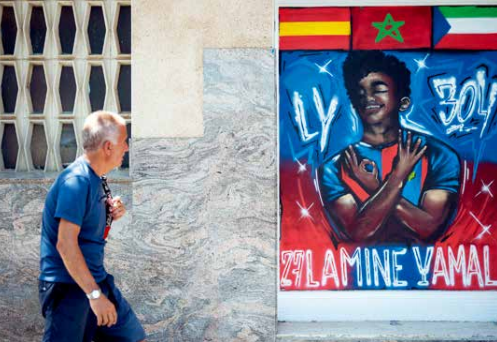
Lamine Yamal was born on 13 July 2007 in Mataró, Barcelona, Catalonia, Spain.He is a Spanish football player who typically operates on the right flank as an “inverted” left‑footed winger for FC Barcelona. Known for his close control, trickery with the ball, and passing range and creativity, Yamal is considered one of the sport’s most talented young stars.
Jose Ignacio Aparicio Ciria is Deputy of the Catalan Parliament, a member of the Sports Commission in Catalan Parliament.
Recently,Global People had a conversation with Jose Igbacio about Yamal.
Global People: Lamine Yamal was born in Rocafonda.What is it like to grow up in Rocafonda? In such an environment, does it easy for a child to change their destiny through sport?
Jose Ignacio:Rocafonda is a working-class neighbourhood of Mataró, with great cultural and social diversity. Like many working-class areas in Catalonia, it is home to families who have come from different places in search of opportunities to build a better future for their children.
Growing up there means living alongside complex realities, but also alongside immense human richness. There are difficulties, of course, but there is also a strong sense of community, hard work, neighbourhood associations, committed schools, sports clubs and people who believe in collective progress.
For a child who wants to play football, it is not always easy. That is why public policies, municipal sports facilities and the work of grassroots clubs are so important. Cases such as Lamine Yamal’s show that talent exists in every neighbourhood; the difference lies in the opportunities available.
Global People:What does it mean for Rocafonda that Yamal is known worldwide now?
Jose Ignacio:It is a source of enormous pride.
Not only because he has reached the elite of world football, but because many residents feel that someone who shares their origins and experiences has shown that dreams are possible.
However, I believe the most important message is not an individual one. What truly matters is that Yamal helps to break stereotypes about certain neighbourhoods. Places like Rocafonda are often spoken about only in terms of their problems. Now the world can also see the talent, diversity and potential that exist there.
Global People:Yamal joined La Masia at the age of 7 and made his first-team debut for Barcelona at 15. How important has the Spanish training system been for Yamal's long-term development?
Jose Ignacio:It has been fundamental.
Lamine Yamal possesses extraordinary talent, but no talent reaches such heights without structures to support it.
La Masia is probably one of the finest sporting academies in the world, but behind it there is also a very extensive network of grassroots football, local clubs, municipal sports schools and federations that make it possible to identify and develop talent from an early age.
This model exists across much of Spain, and particularly in Catalonia, where the sporting associative fabric is remarkably strong. It is important to understand that Yamal’s success is the result both of his personal talent and of a collective investment made over many years.
Global People:Are there generational differences in how Yamal is perceived?
Jose Ignacio:I believe so, although they are natural differences.
Young people see in Yamal someone very close to their own reality. They share cultural references, ways of communicating and a more diverse vision of society.
Older generations also admire his footballing quality, although they sometimes draw inevitable comparisons with figures from other eras such as Raúl, Casillas, Iniesta or Xavi.
I do not believe there is any significant generational rejection. Rather, we are seeing how each generation projects its own references onto him. What does seem clear is that Yamal connects in a very special way with a more diverse and multicultural Spain and Catalonia.
Global People: Do you think the perception of "what it means to be Spanish" might shift a little bit because of Yamal?
Jose Ignacio:I believe so, although gradually and naturally.
Lamine Yamal represents a reality that already exists in our streets, in our schools and in our neighbourhoods.
He is Catalan.He is Spanish.
He has diverse family roots.
All of this forms part of his identity without contradiction.
Perhaps what is changing is not Yamal, but the way society sees itself. New generations increasingly understand that identity can be plural, open and compatible with different cultural origins.
In this sense, figures like Yamal help to normalise a reality that is already part of twenty-first-century Catalonia and Spain.
Global People: How would you like the world to remember Yamal?
Jose Ignacio:I would like him to be remembered as more than an extraordinary footballer.
I would like him to be remembered as someone who used his talent to inspire millions of young people.
As someone who showed that one’s social background or the neighbourhood in which one is born need not determine one’s future.
As a symbol of a diverse, open and cohesive society.
And also as an example of how, when a community, a school, a family, a club and public institutions work together, they can help talent to flourish.
Because the story of Lamine Yamal is not only the story of an exceptional player. It is also the story of a society that was able to give him the opportunity to go as far as his talent would allow.
 Editor:Gao Weiyi

